01 Opening snapshot
One daily loop for preparation, execution, and reflection.
Libertrade LOOP is a process-first trading journal for discretionary futures traders. It connects readiness, planning, risk, execution, and review so lessons can influence the next decision—not simply describe the last one.
- Who it serves
- Discretionary futures traders operating under time, risk, and emotional pressure.
- Core problem
- The plan, the trade, and the lesson live in separate places.
- Current signal
- Early product build. Validation evidence and baseline measurements will be added here.
02 The trading problem
The problem wasn’t missing analytics. It was a broken feedback loop.
Traders prepare, execute, and reflect in different tools—or skip parts entirely. Risk decisions then move into the most pressurised moment, while journals explain P&L after the fact instead of reinforcing a better process before the next session.
Prepare
Bias and levels in notes, charts, or memory.
Execute
Risk choices made live while attention is divided.
Record
Broker data captures outcomes, not decision quality.
Reflect
Lessons are written down but rarely carried forward.
Chosen opportunity
Bring readiness, planning, execution, and reflection into one low-friction daily cycle.
- Keep the trader’s state visible before capital is at risk.
- Commit risk decisions before the market creates urgency.
- Review adherence separately from whether the session made money.
03 — Product thesis
Better performance does not come from recording more data alone. It comes from reinforcing a better decision process every trading day.
- 01Process before outcome
- 02Decisions before pressure
- 03Readiness before risk
- 04Reflect while the session is fresh
- 05Carry one lesson into the next session
- 06Useful structure without excessive friction
04 The LOOP model
A closed process, not another collection of dashboards.
Each stage prepares the next. Supporting features extend this cycle; they do not compete with it.
- 01 →
Check-in
State, mindset, context
- 02 →
Session plan
Bias, levels, setups, risk
- 03 →
Trade
Plan and risk rails in view
- 04 →
Close the loop
Import, adherence, reflection
- 05 →
Review patterns
History, analytics, weekly review
- 06
Next session
Carry one lesson forward
05 Three product deep dives
The decisions that make the daily loop useful.
Each chapter will document the problem, insight, design decision, iteration, final experience, and evidence.
Deep dive 01
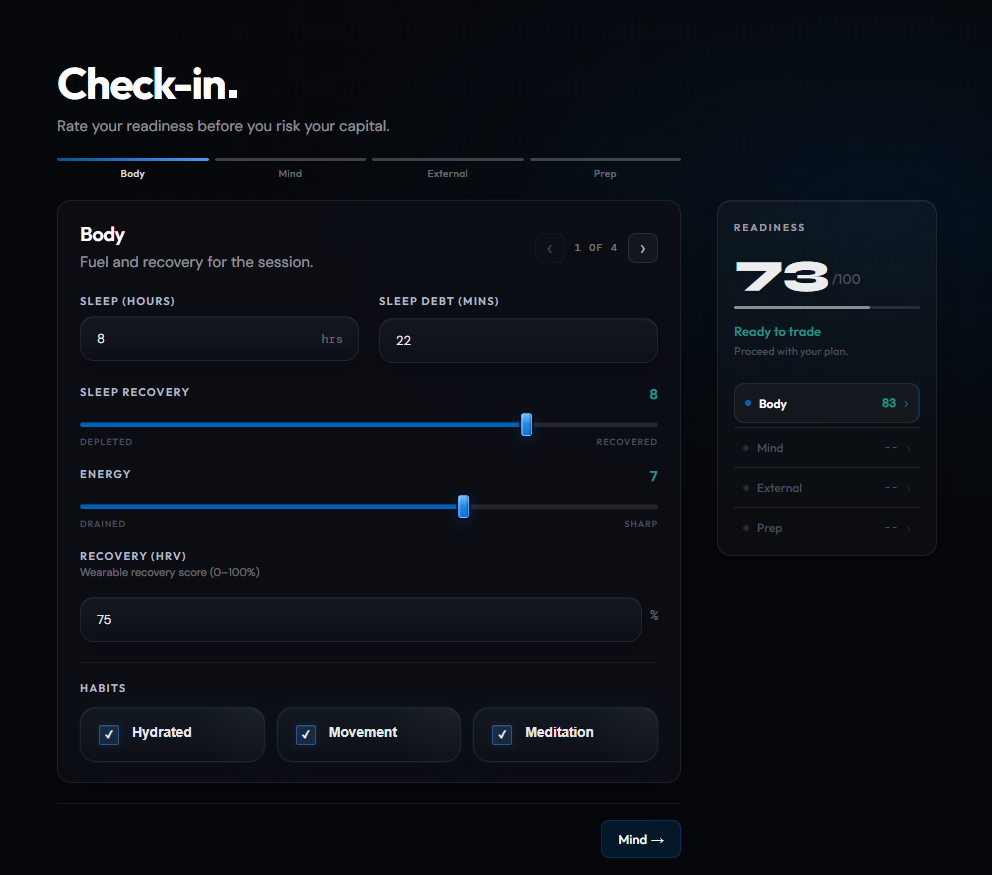
Knowing your state before risking capital
Readiness affects decisions but is usually considered informally.
The check-in must be useful without becoming a long questionnaire.
Capture only state inputs that can change the session plan or warning state.
Testing notes and readiness-to-plan conversion will be documented here.
Deep dive 02
Removing decisions from the moment
Bias, limits, and invalidation become negotiable under pressure.
Risk has to be committed while the trader can still think deliberately.
Keep the plan and risk rails visible without pretending the product controls behaviour.
Plan completion and adherence signals will be documented here.
Deep dive 03
Reviewing process rather than only P&L
A green day can hide broken rules; a red day can still contain good decisions.
The useful review compares planned behaviour with actual behaviour.
Close each session while context is fresh and carry one lesson forward.
Close-loop completion and weekly review usage will be documented here.
06 Supporting product system
A broader product organised around the daily loop.
The supporting system reveals patterns over time without turning every capability into a separate story.
Home dashboard
Today’s state, plan, and open loop
History & calendar
Sessions placed in time and context
Trade analytics
Patterns across setups, timing, and risk
Process adherence
Plan quality separated from P&L
Weekly reviews
A deliberate adjustment for the next week
Prop-firm economics
Rules, drawdown, and account constraints
LOOP Intelligence
Assisted synthesis across the workflow
Process settings
Personal rules without rebuilding the system
07 Validation and outcomes
Evidence at the right level of maturity.
No invented metrics. This framework separates what has been observed from what the next validation cycle must measure.
Usability
Can traders understand and complete the workflow?
- Onboarding completion
- Check-in to plan conversion
- Points of confusion or abandonment
Behaviour
Do traders return and consistently close the loop?
- Completed close-loop reviews
- Weekly review usage
- Return frequency
Product value
Does LOOP improve pattern recognition and risk decisions?
- Risk-plan adherence
- Useful patterns identified
- Qualitative trader feedback
Add usability findings, product behaviour, trader feedback, and changes made after testing.
08 — Reflection and next chapter
The most important design challenge was not helping traders document the past. It was making yesterday’s lesson useful before the next trade.
What changedThe product moved from an analytics-first idea toward a process-first operating loop.
What remainsValidate which moments deserve structure and where structure becomes friction.
Next questionCan LOOP reinforce better risk decisions without becoming another task to maintain?